For decades, national security was measured in familiar terms: military power, energy security, industrial capacity, and control over strategic resources. Nations worried about oil supply routes, semiconductor imports, and military alliances because these were the foundations upon which power rested.
Artificial Intelligence is now joining that list.
The global conversation around AI is often dominated by chatbots, image generators, and the race between technology companies. Yet beneath the headlines, a far more consequential competition is emerging. The world’s major powers are increasingly treating AI not as a technology sector but as strategic infrastructure.
The United States has imposed restrictions on advanced AI chip exports. China has responded by leveraging its dominance in critical mineral processing and rare earth supply chains. DeepSeek’s emergence demonstrated that countries facing technology restrictions will attempt to innovate around them rather than surrender technological leadership.
These developments point toward a larger reality.
The future of AI may be determined less by who builds the most impressive model and more by who controls the infrastructure required to build and operate those models.
This raises an uncomfortable question for India.
How sovereign is India’s AI future?
The Difference Between AI Applications and AI Sovereignty
India’s AI ambitions are substantial.
The country is investing in AI infrastructure, supporting domestic foundation models, building language datasets, and expanding digital public infrastructure. Discussions about sovereign AI have become increasingly common among policymakers and technology leaders.
However, AI sovereignty is frequently misunderstood.
Building an AI application is not the same thing as controlling the AI stack.
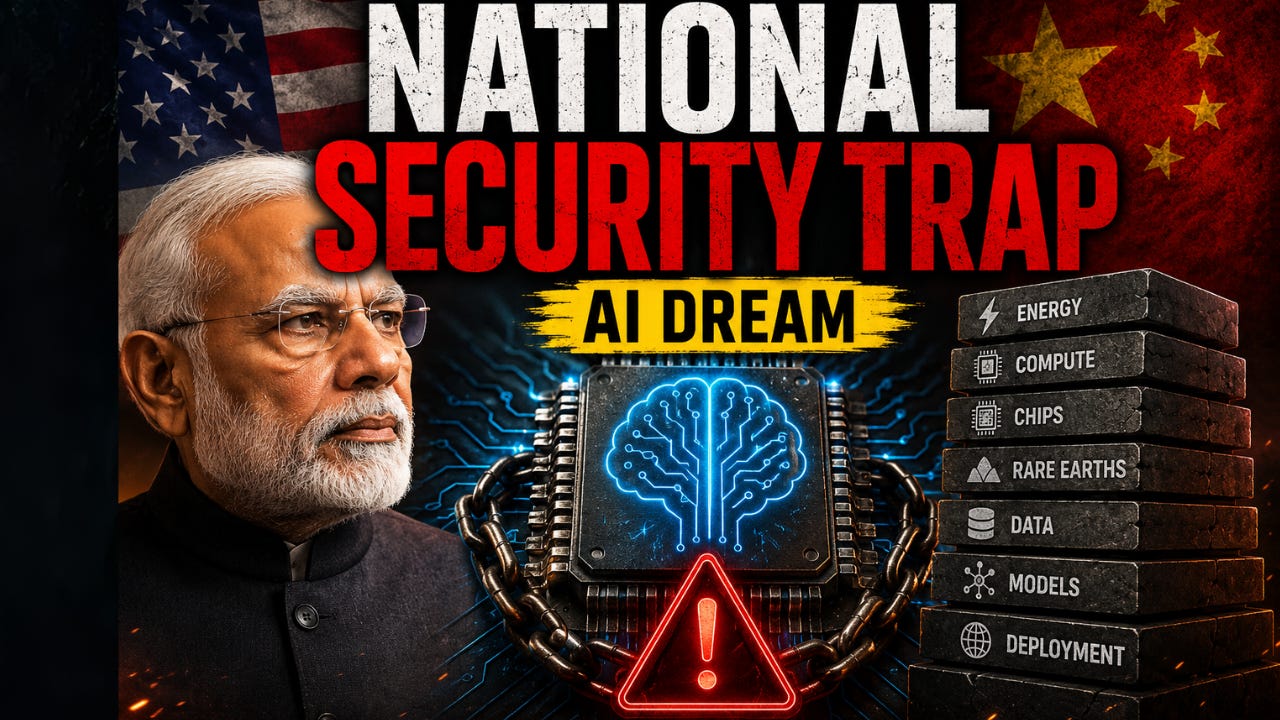
True AI sovereignty requires control over multiple layers of infrastructure:
-
Energy
-
Compute
-
Semiconductors
-
Critical minerals
-
Data
-
Models
-
Deployment systems
The challenge for India is that strength in one layer does not compensate for weakness in another.
A nation may possess enormous quantities of data but remain dependent on foreign compute infrastructure. It may develop impressive AI models while relying on imported chips and foreign cloud platforms.
The question is not whether India can use AI.
The question is whether India can control the infrastructure that produces AI.
Where India Is Strong
India’s greatest advantage lies in data and deployment.
With more than 1.4 billion people, India possesses one of the world’s largest and most diverse digital populations. The country’s public digital infrastructure—including Aadhaar, UPI, DigiLocker, and ONDC—has created datasets and deployment opportunities that few countries can replicate.
Unlike many nations, India already possesses nationwide digital rails capable of supporting large-scale AI deployment.
This matters.
The ultimate value of AI is not created during model training. It is created when AI becomes embedded in healthcare, education, governance, agriculture, finance, logistics, and defense.
India is exceptionally well positioned in this regard.
Few countries possess both the scale and institutional infrastructure necessary to deploy AI across an entire society.
This is one of the reasons India remains a serious contender in the global AI race despite its weaknesses elsewhere.
Where India Remains Vulnerable
The deeper layers of the AI stack present a very different picture.
Modern AI depends on enormous quantities of compute power. That compute power depends on advanced graphics processors. Those processors depend on highly sophisticated semiconductor manufacturing, advanced memory technologies, rare earth supply chains, and reliable energy infrastructure.
In each of these categories, India remains significantly behind both the United States and China.
The United States dominates AI chip design through companies such as Nvidia and AMD. It controls much of the software ecosystem upon which modern AI development depends and hosts many of the world’s largest AI compute clusters.
China, while constrained by American export restrictions, possesses a much deeper manufacturing ecosystem and greater control over critical mineral processing and industrial supply chains.
India, by contrast, is still building many of these capabilities.
This does not mean India lacks progress.
It means India remains dependent.
The distinction is important.
Access to technology is not the same thing as control over technology.
A nation that imports critical infrastructure remains vulnerable to supply disruptions, export controls, geopolitical pressure, and technological blockades.
The New Strategic Resource
For most of modern history, economic and military power depended upon access to energy.
The twenty-first century may introduce a new strategic resource.
Compute.
Just as oil became indispensable to industrial civilization, compute is becoming indispensable to the emerging AI economy.
Every AI model requires compute.
Every compute cluster requires chips.
Every chip requires an industrial ecosystem.
Every industrial ecosystem requires energy and critical materials.
This creates a chain of dependencies that extends far beyond software.
Consequently, AI sovereignty is no longer simply a technology policy objective.
It is increasingly a national security objective.
A Race Against Time
India’s AI challenge is not technological capability alone.
It is timing.
The global AI ecosystem is consolidating rapidly. Supply chains are hardening. Export controls are expanding. Strategic dependencies are becoming more visible.
The longer India remains dependent on foreign-controlled infrastructure, the greater the risk that future AI capabilities will be built upon foundations outside India’s control.
This does not mean India cannot succeed.
India possesses genuine strengths that many countries lack. Its digital public infrastructure, population scale, language diversity, and growing technology ecosystem provide a strong foundation.
However, success will require more than building AI applications.
It will require building the infrastructure beneath those applications.
The countries that dominate the AI era may not necessarily be those that build the smartest models.
They may be the countries that control the energy, compute, chips, minerals, data, and deployment systems that make those models possible.
That is the national security trap behind India’s AI dream.
And it may become one of the defining strategic challenges of the coming decade.