For decades, geography has been one of the most underrated forces in global politics.
Countries talk about trade agreements, strategic partnerships, and diplomatic summits, but beneath all of these lies a much simpler question:
How do goods actually move from one country to another?
For Russia and India, this question has become increasingly important.
The two countries have expanded their economic relationship dramatically in recent years. India has become one of the largest buyers of Russian energy, while Russia has emerged as a critical supplier of oil, fertilizers, coal, and strategic commodities.
Yet there was a problem.
A large trade relationship existed without an efficient trade route.
The Geography Problem
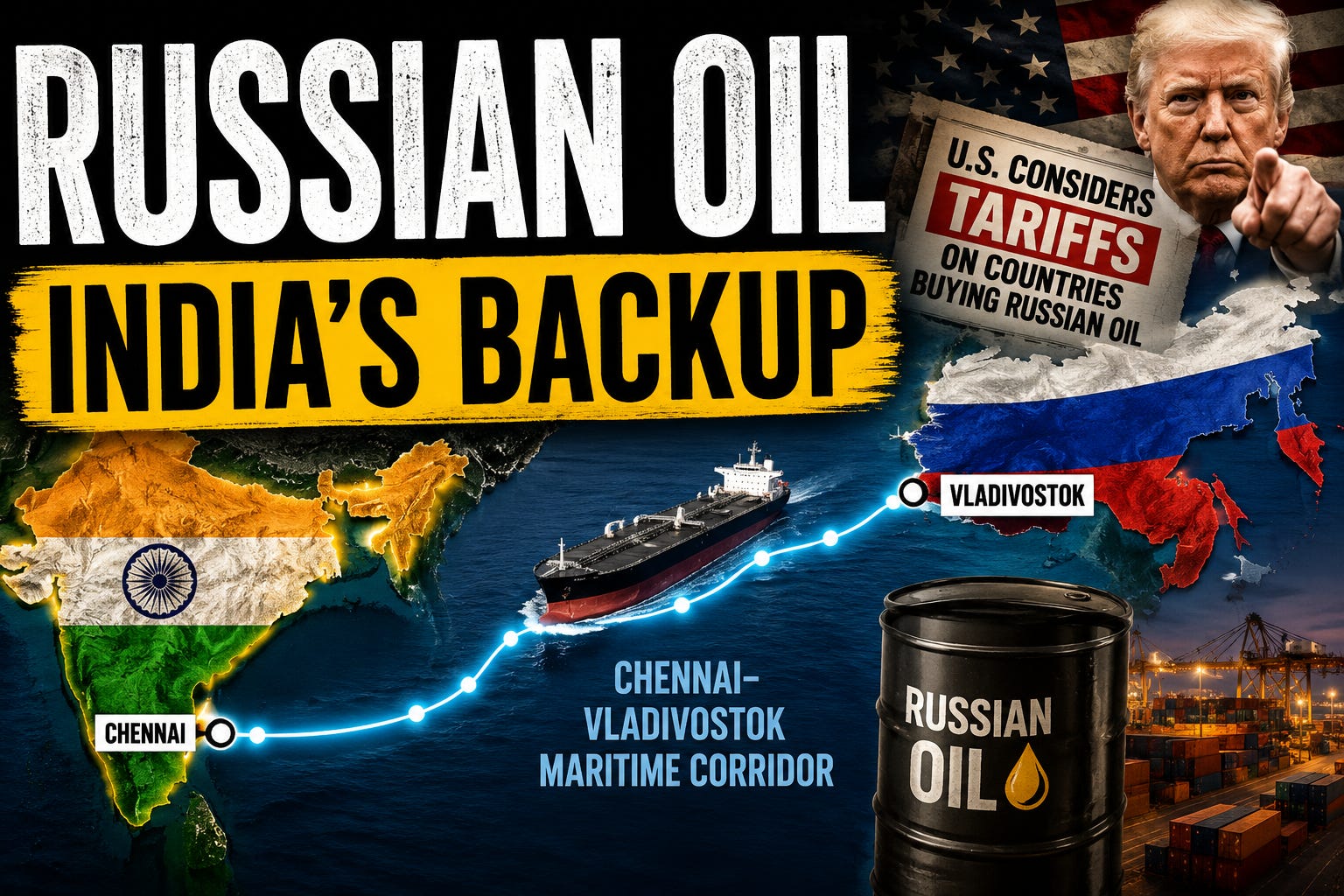
Historically, trade between Russia and India relied heavily on long maritime routes.
Goods often had to travel through the Baltic Sea, around Europe, through the Mediterranean, across the Suez Canal, and then into the Indian Ocean.
The route worked.
But it was slow.
Expensive.
And vulnerable to disruption.
The more trade increased, the more obvious the bottleneck became.
A strategic partnership was being constrained by logistics.
This is a common pattern in international relations.
Countries often focus on political agreements while overlooking the physical infrastructure required to sustain them.
Trade corridors determine whether economic relationships can scale.
Without corridors, partnerships eventually hit a ceiling.
Why This Matters For Russia
Following Western sanctions, Russia faced a new reality.
Its traditional trade networks with Europe became increasingly constrained.
Moscow needed alternative markets.
More importantly, it needed alternative routes.
India emerged as one of the most important destinations for Russian exports.
But exporting more products is only useful if those products can move efficiently.
This created a strategic dependency.
Russia needed reliable access to growing Asian markets.
India represented one of the largest opportunities available.
Why This Matters For India
India’s interest extends far beyond purchasing discounted Russian oil.
India’s long-term objective is much larger.
New Delhi wants to become a major manufacturing, logistics, and trading hub connecting Europe, Central Asia, the Middle East, and the Indo-Pacific.
That ambition requires access.
Access to resources.
Access to markets.
Access to transportation corridors.
The stronger India’s connectivity with Eurasia becomes, the greater its strategic autonomy.
In other words, this is not simply about buying oil.
It is about building options.
And in geopolitics, options are power.
The Solution: The International North-South Transport Corridor
The International North-South Transport Corridor (INSTC) represents one of the most important but least discussed infrastructure projects in Eurasia.
The corridor connects India with Russia through a network of ports, railways, and roads passing through Iran and the Caspian region.
Rather than relying solely on traditional maritime routes, goods can move through multiple interconnected pathways.
The result is shorter transit times.
Lower transportation costs.
And greater resilience.
Most importantly, the corridor reduces dependency on a single route.
This is the real strategic value.
Nations become vulnerable when too much trade depends on one pathway.
The INSTC creates redundancy.
And redundancy creates security.
The Hidden Lesson
Most geopolitical analysis focuses on leaders.
Presidents.
Prime ministers.
Diplomatic meetings.
Yet the real story is often happening underneath.
Infrastructure shapes outcomes long before politics catches up.
Trade corridors influence power.
Ports influence influence.
Railways influence alliances.
When countries build alternative routes, they are not simply moving goods.
They are reshaping the map of economic power.
The Bigger Consequence
The significance of India’s role in solving Russia’s trade bottleneck extends beyond the bilateral relationship.
It reflects a broader trend visible across the international system.
Countries are increasingly searching for alternatives.
Alternative payment systems.
Alternative energy suppliers.
Alternative transportation corridors.
Alternative strategic partners.
The world is becoming more interconnected while simultaneously becoming less dependent on any single center of power.
That is one of the defining characteristics of an emerging multipolar order.
The story of India and Russia is therefore not just about trade.
It is about how nations reduce vulnerabilities.
How they build resilience.
And how infrastructure quietly reshapes global power long before headlines notice.
The future of geopolitics may not be decided by speeches or summits.
It may be decided by who controls the routes connecting the world’s most important economies.