There are leaders who win elections.
There are leaders who govern countries.
And then there are leaders who permanently alter the trajectory of nations.
History remembers the third category.
The real question surrounding Narendra Modi is not whether he is popular. The real question is whether he belongs in that third category.
Love him or hate him, India today is fundamentally different from the India of 2014. Its economy is larger. Its military posture is more assertive. Its diplomatic influence is greater. Its civilizational confidence has returned. Most importantly, India’s ambitions have changed.
For many Indians, Modi did not simply become Prime Minister. He became the leader who restored India’s belief in itself.
Whether one agrees with that assessment or not, it is impossible to deny that Modi has become one of the defining political figures of the 21st century.
The case for Modi’s historical significance rests on five pillars: foreign policy, economic transformation, national security, civilizational revival, and the long-term legacy of the systems he built.
Foreign Policy: How Bharat Became A Global Power
Perhaps the most important reason for Modi’s popularity is that many Indians believe he restored India’s status in the world.
For decades, India was viewed as a country with enormous potential but limited influence. It was respected but rarely feared. Consulted but rarely decisive. Large but not necessarily powerful.
Under Modi, that perception began to change.
India pursued a strategy of balancing relations with America, Russia, Europe, the Gulf states, Japan, Africa, and the Global South simultaneously. Rather than joining a bloc, India sought to become a pole of its own.
The Ukraine War became the greatest test of this strategy. While much of the world divided into competing camps, India maintained relations with both Russia and the West. It resisted pressure to abandon its national interests and continued pursuing strategic autonomy.
The 2023 Group of Twenty summit became a defining moment. India secured a consensus declaration despite deep divisions among major powers and helped facilitate the African Union’s entry into the Group of Twenty.
The launch of the India-Middle East-Europe Economic Corridor further strengthened India’s position within emerging global trade architecture.
At the same time, India increased diplomatic pressure on Pakistan, expanded its influence across the Global South, and positioned itself as a major alternative manufacturing destination as global supply chains diversified away from China.
For Modi’s supporters, these developments represent something larger than diplomacy.
They represent status.
The belief that India is no longer a country seeking recognition, but a country that other major powers must recognize.
Modinomics: How Bharat Became An Execution State
Economic growth alone does not explain Modi’s appeal.
India has experienced periods of growth before.
What distinguishes the Modi era is the emphasis on execution.
For decades, Indian governments announced ambitious policies. Modi’s supporters argue that his government focused on implementation.
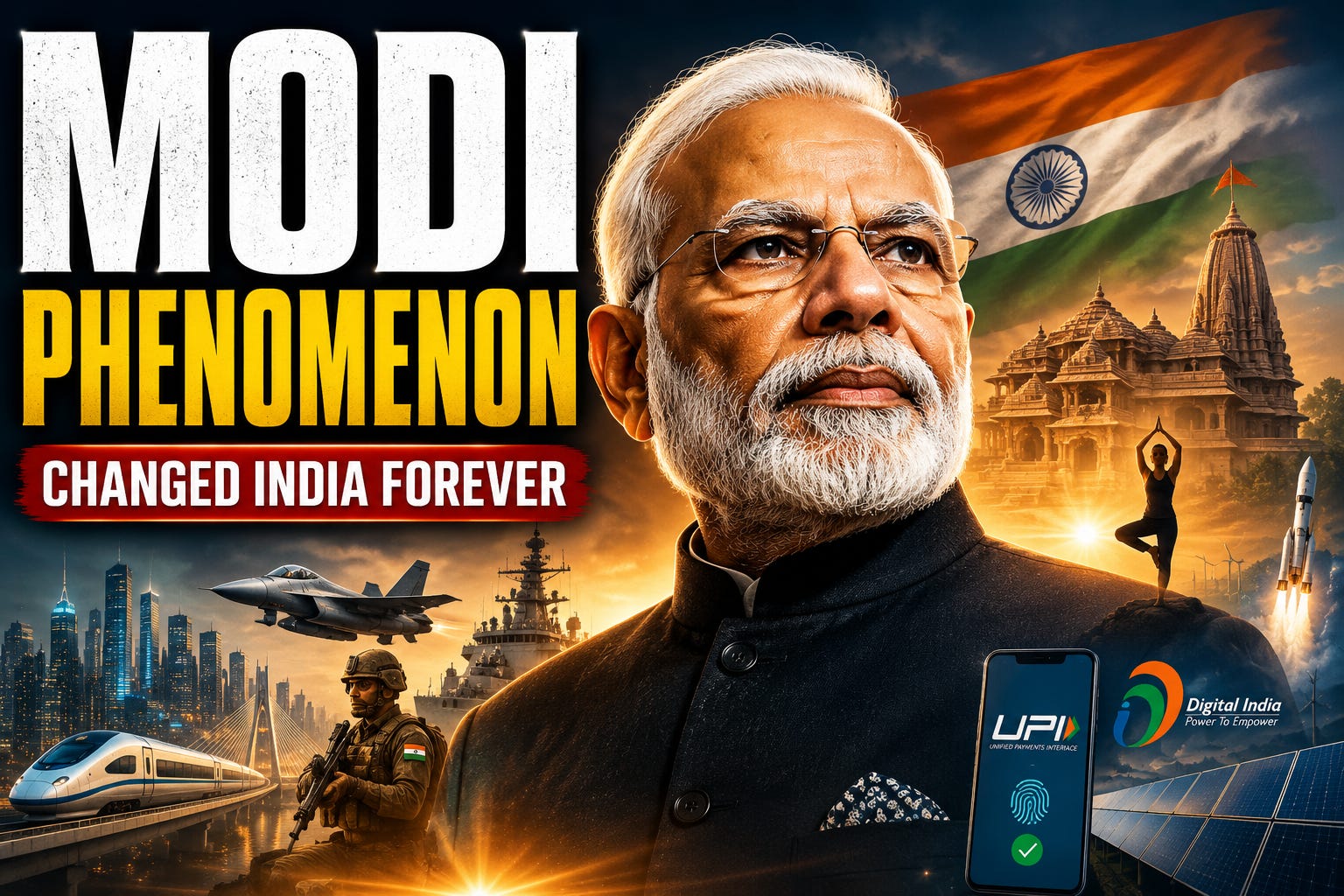
The most visible example is India’s Digital Public Infrastructure.
Aadhaar, Unified Payments Interface, and Direct Benefit Transfer systems transformed how the state interacts with citizens. Welfare delivery became faster, digital payments exploded, and India created one of the world’s most sophisticated public digital ecosystems.
Infrastructure became another defining feature.
Highways, airports, ports, logistics corridors, rail modernization, and border infrastructure expanded at unprecedented scale.
At the same time, the Make in India initiative sought to reduce dependence on foreign suppliers and strengthen domestic manufacturing capacity.
Production Linked Incentive programs targeted electronics, semiconductors, defense production, and other strategic industries.
One of the most visible outcomes has been the growth of India’s defense manufacturing sector. A country once heavily dependent on imports now increasingly exports military equipment abroad.
For Modi’s supporters, Modinomics is not simply about Gross Domestic Product growth.
It is about state capacity.
The ability of the Indian state to execute large projects, deliver services, and build strategic self-reliance.
National Security: How Modi Rebuilt India’s Deterrence
If foreign policy changed India’s external status, national security changed India’s strategic mindset.
For decades, Indian security policy was often characterized by restraint.
Under Modi, supporters argue that the country shifted from a reactive posture to a deterrence posture.
Terrorism increasingly came to be viewed not merely as a law-and-order challenge but as a national security threat requiring direct response.
India’s responses to cross-border attacks signaled a willingness to impose costs on adversaries.
Supporters frequently point to India’s willingness to conduct military operations against a nuclear-armed adversary as evidence of this shift.
At the same time, border infrastructure accelerated significantly following tensions with China.
Roads, tunnels, airfields, and logistics networks along sensitive frontiers expanded.
Defense production and defense exports also grew substantially under the broader Atmanirbhar Bharat initiative.
The concept of national security itself expanded.
Security was no longer limited to armies and borders. It increasingly included supply chains, technology, energy security, maritime access, and strategic resilience.
India’s maritime strategy became more prominent as the Indian Ocean and Indo-Pacific emerged as central theaters of global competition.
For Modi’s supporters, the most important change was psychological.
India no longer viewed itself primarily as a country responding to threats.
It increasingly viewed itself as a country capable of shaping outcomes.
Civilizational Bharat: How India Stopped Apologizing For Itself
Economic growth and military strength alone cannot explain the emotional connection many supporters feel toward Modi.
The deeper reason lies in identity.
Modi brought civilizational language back into mainstream politics.
Concepts such as Bharat, Sanatan civilization, cultural heritage, and civilizational continuity became increasingly prominent in national discourse.
The Ram Mandir became one of the defining symbols of this transformation.
Supporters viewed it not simply as a religious project but as a civilizational milestone.
India increasingly presented itself to the world as an ancient civilization and a modern nation simultaneously.
Yoga, heritage restoration projects, temples, Sanskritic symbolism, and civilizational diplomacy became tools of soft power.
For many overseas Indians, this shift produced a renewed sense of pride.
The post-colonial hesitation that often shaped earlier narratives gave way to a more confident expression of Indian identity.
Supporters argue that Modi reminded India of something it had forgotten.
That India is not merely a nation-state.
It is a civilization.
And that civilization has a name: Bharat.
The Long Shadow Of Modi
Ultimately, consequential leaders are judged not by what happens during their tenure but by what survives after they leave.
This is where the strongest argument for Modi’s historical significance emerges.
His supporters argue that Modi’s most important achievements are systemic.
They extend beyond elections and political cycles.
India’s digital infrastructure will likely outlast him.
The emphasis on strategic autonomy will likely outlast him.
The shift toward self-reliance in critical sectors may outlast him.
The civilizational language he reintroduced into politics may outlast him.
Even voter expectations have changed.
Increasingly, citizens expect delivery, execution, infrastructure, and visible results.
In this sense, Modi’s supporters believe he altered not merely policies but assumptions.
Assumptions about what India can become.
Modi has often spoken about preparing India not for the next election but for the next thousand years.
Whether one considers that vision realistic or aspirational is ultimately beside the point.
The significance lies in the ambition itself.
For much of its post-independence history, India focused on managing scarcity.
Today, India increasingly speaks the language of leadership.
Leadership in economics.
Leadership in technology.
Leadership in military power.
Leadership in science.
Leadership in global governance.
That shift in ambition may prove to be Modi’s most enduring legacy.
Conclusion
The debate over Narendra Modi will continue for decades.
Critics will point to failures, controversies, and missed opportunities.
Supporters will point to transformation, ambition, and national renewal.
History will make its own judgment.
But one thing is already clear.
Narendra Modi is not merely another Prime Minister in India’s long political history.
He is a leader who changed how India sees itself, how the world sees India, and what Indians believe is possible.
Consequential leaders do not simply win elections.
They alter the trajectory of nations.
That is the case many of Modi’s supporters believe history will ultimately make.