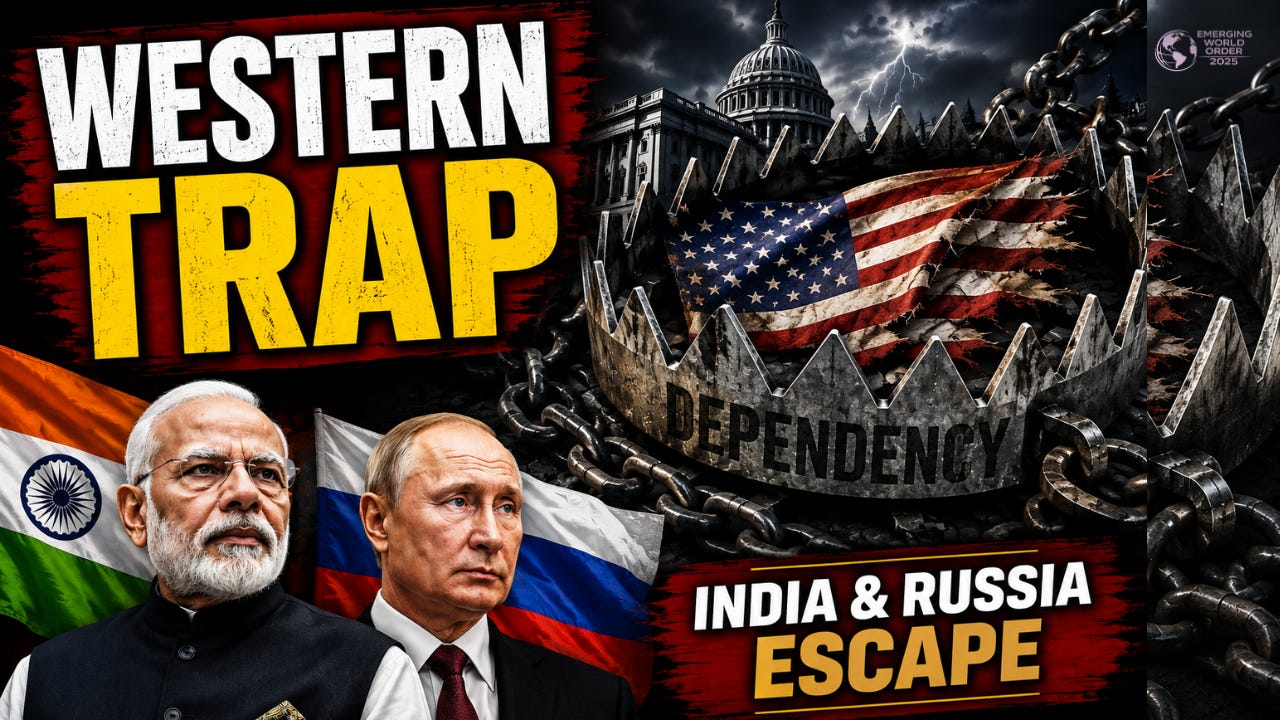
The India–Russia relationship is often explained through oil deals, weapons sales, or nostalgia from the Cold War era.
That misses the larger story.
This relationship survived the collapse of the Soviet Union, economic crises, sanctions, and major geopolitical shifts because it evolved beyond transactions.
It became structural.
For decades, India and Russia kept solving strategic problems for each other in exactly the areas where larger powers often create dependence: diplomacy, finance, energy, defense, and geopolitical isolation.
The result was not an alliance in the traditional sense.
It became a mechanism for preserving strategic autonomy.
The First Trap: Diplomacy
Before oil, before BRICS, and before sanctions, the first battleground was diplomatic alignment.
After independence, India faced wars in 1947, 1965, and 1971, along with the 1962 conflict with China.
The Cold War divided the world into competing blocs.
The West wanted India integrated into its strategic architecture.
The Soviet Union wanted India outside Western military structures.
India chose a different path: strategic autonomy.
Moscow saw strategic value in that.
A large independent India outside Western alliances complicated Western influence across Asia.
The Soviet Union repeatedly backed India at the United Nations. During the Bangladesh Liberation War in 1971, the Indo‑Soviet Treaty of Peace, Friendship and Cooperation became a turning point.
When the USS Enterprise-led Seventh Fleet moved into the Bay of Bengal, Soviet support altered the strategic equation.
India gained diplomatic space.
But later, India also solved a problem for Russia.
After the Soviet collapse, Russia entered economic chaos.
Inflation surged above 2,000 percent. Industries collapsed. Boris Yeltsin pursued closer integration with Western institutions.
Many expected Russia to become permanently absorbed into the Western order.
Instead, India remained one of Russia’s most reliable strategic partners and defense customers.
The relationship became reciprocal.
The Dollar and Energy Trap
After the Cold War, control shifted.
Military alliances mattered less.
Financial systems mattered more.
The dollar became central to global trade.
Russia later experienced pressure through sanctions and financial restrictions.
India faced another problem.
India imports more than 85 percent of its crude oil requirements.
That means oil prices and dollar movements directly affect inflation, trade balances, and currency stability.
Russia needed large buyers outside Western pressure.
India needed reliable and affordable energy.
Before the Ukraine war, Russian oil represented less than 2 percent of India’s crude imports.
By 2023–2024, Russia became India’s largest oil supplier, at times accounting for more than 35 percent of Indian imports.
But India did not simply buy oil.
India possesses refining capacity exceeding 250 million metric tonnes annually, making it one of the world’s largest refining hubs.
Russian crude entered India.
India refined it.
Petroleum products then moved into global markets.
Russia had supply.
India had demand.
Both solved a strategic problem for each other.
The Defense and Technology Trap
Defense dependence eventually becomes political dependence.
If another country controls spare parts, maintenance, upgrades, and logistics, strategic flexibility narrows.
India wanted diversification.
Russia needed long-term strategic partners.
The relationship evolved beyond simple weapons sales.
Examples include:
-
Su‑30MKI licensed production
-
BrahMos joint missile development
-
S‑400 systems
-
Nuclear submarine cooperation
Even today, roughly 45–60 percent of India’s military inventory still has Soviet or Russian origins.
The relationship also expanded into technology cooperation.
Following sanctions after India’s nuclear tests, Russia supported India’s nuclear and space sectors, including cryogenic engine cooperation and support for projects such as Kudankulam.
The relationship moved from buyer–seller to co-development.
The Isolation Trap
The modern system works best when countries remain isolated inside their vulnerabilities.
Russia isolated from markets becomes vulnerable.
India isolated from strategic depth and energy access becomes vulnerable.
Together, both reduced weaknesses.
India provides:
-
Market scale
-
Long-term growth
-
Military-age population
Russia provides:
-
Energy
-
Defense depth
-
Nuclear deterrence
That is why the relationship survived:
-
The Soviet collapse
-
Economic crises
-
Sanctions
-
Geopolitical shifts
Because over time the relationship stopped being ideological.
It became structural.
Final Thought
India and Russia did not become strategically closer because of nostalgia.
They became strategically closer because they kept reducing vulnerabilities for each other.
Diplomatic vulnerability.
Financial vulnerability.
Energy vulnerability.
Defense vulnerability.
Isolation vulnerability.
That is the deeper lesson.
Countries preserve sovereignty not by declaring independence once.
They preserve it by continuously reducing the systems that can control them.
And for decades, India and Russia helped each other do exactly that.