For years, we have heard the same prediction repeated again and again: the petrodollar is finished.
Saudi Arabia is talking to China. BRICS countries are experimenting with local currencies. Russia has been pushed outside parts of the Western financial system. Iran has every incentive to avoid the dollar. More countries are openly discussing alternatives to dollar-based trade.
From that perspective, the conclusion seems obvious.
If Middle Eastern oil gradually moves away from the dollar, then the petrodollar system must eventually collapse with it.
But there is another possibility that receives far less attention.
What if America does not need to preserve the old petrodollar system at all?
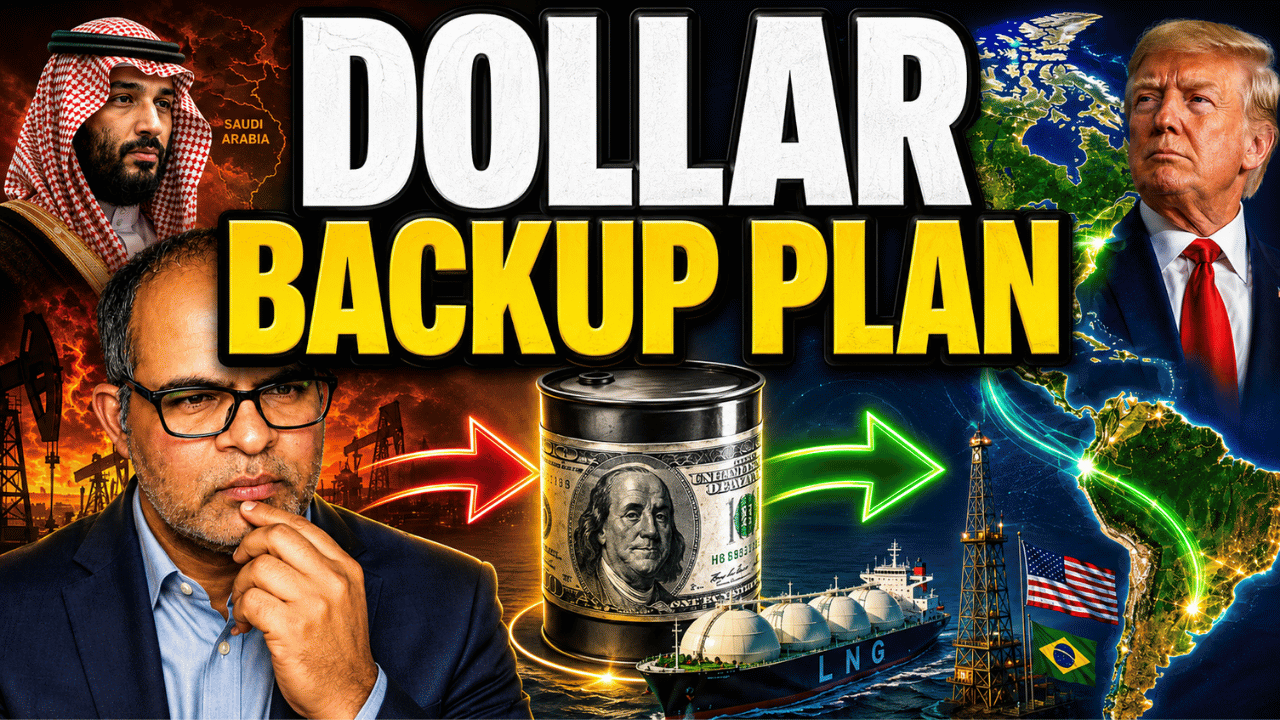
What if Washington is instead building a replacement structure in which the world continues buying enormous quantities of oil and natural gas in dollars — except an increasing share of that energy comes from the Western Hemisphere rather than the Middle East?
That changes the entire conversation.
The petrodollar may not need Saudi Arabia as much as most people assume.
America may simply need energy.
And the Western Hemisphere has plenty of it.
The Petrodollar Was Never Really About Saudi Arabia
Saudi Arabia became central to the petrodollar system because Saudi Arabia was one of the most important suppliers of globally traded oil.
The basic arrangement was straightforward.
The world needed oil.
The Gulf had enormous quantities of it.
Much of that oil was priced and traded in dollars.
Countries therefore needed access to dollars to purchase energy, while oil-producing states accumulated enormous dollar revenues that often flowed back into American financial assets.
The system gave Washington two advantages.
First, the dollar remained deeply embedded in global energy trade.
Second, America developed an enormous strategic interest in keeping Gulf oil flowing.
That is why the Persian Gulf became much more than another region on the map. It became part of the infrastructure supporting the global economic system.
But circumstances have changed dramatically.
The United States itself is now one of the world’s largest energy producers.
Canada is deeply integrated into the American energy market.
Brazil has become a major offshore producer.
Guyana has emerged almost overnight as one of the world’s most important new oil-producing regions.
Argentina possesses enormous shale potential.
Venezuela still sits on one of the largest oil resource bases on the planet.
Even countries such as Bolivia matter when we broaden the discussion from oil to natural gas and the overall energy supply chain.
Put these pieces together and something interesting starts to appear.
The Western Hemisphere increasingly looks capable of becoming an energy bloc in its own right.
Step One: Build the Energy Base
The first requirement for any alternative to Middle Eastern dependence is obvious.
You need enough energy.
America has spent the last decade unintentionally building exactly that.
The shale revolution transformed the United States from a country obsessed with energy scarcity into a major oil and gas producer.
American LNG exports then turned natural gas into another geopolitical instrument.
Canada provides another enormous layer of oil and gas production directly connected to the United States.
Further south, Brazil continues expanding offshore production.
Guyana may be an even more important story because its transformation has happened so quickly.
Argentina’s Vaca Muerta shale formation offers another potential source of future production.
And Venezuela remains the giant wildcard.
If Venezuelan production were ever normalized and reintegrated into a Western-oriented energy system, the scale of the Western Hemisphere’s resource base would change dramatically.
America therefore does not need to recreate Saudi Arabia.
It needs enough producers collectively to reduce the strategic importance of any one supplier.
That is a very different objective.
Step Two: Redirect the Buyers
Production alone does not create a new energy order.
Someone has to buy it.
And this is where the real battle begins.
India does not buy oil because it loves Russia, Saudi Arabia, America or anyone else.
India buys oil because more than a billion people need energy and Indian refiners need reliable supplies at competitive prices.
China operates under the same basic logic.
European buyers do the same.
For major importers, the nationality of the producer matters much less than price, reliability, shipping costs, refining compatibility and political risk.
That means the fundamental American challenge is not convincing the world to become politically loyal to Washington.
It is making Western Hemisphere energy commercially attractive enough that major consumers willingly shift part of their supply chain.
If India can purchase competitively priced crude from Guyana, Brazil, Venezuela or other producers, it has no ideological reason to refuse.
If China can secure LNG or crude from the Americas at acceptable prices, the same logic applies.
The producer changes.
The tanker route changes.
The geography changes.
But if the trade remains overwhelmingly denominated, financed and settled through the dollar system, then the monetary architecture survives.
That is the crucial point.
The petrodollar does not necessarily care whether the barrel comes from Riyadh or Georgetown.
Russia Is the Complication
There is, however, a major obstacle.
Russia.
Cheap Russian energy gives major economies an alternative source of supply outside an American-centered Western Hemisphere structure.
India has already demonstrated that when discounted Russian crude is available, it will buy it.
China certainly has no problem doing the same.
That means any American effort to redirect the global energy supply chain toward the Western Hemisphere eventually runs into a simple problem:
How do you compete with Russian energy?
Sanctions can restrict access.
Shipping restrictions can increase costs.
Financial pressure can complicate transactions.
But unless Western Hemisphere suppliers can compete economically, buyers will continue making decisions based on their own interests.
This is why the competition over energy is not merely about production.
It is about price.
The country — or energy bloc — that can provide reliable energy at the right price has enormous geopolitical leverage.
Step Three: Make the Middle East Less Important
This is where the geopolitical consequences become much larger.
The old model looked something like this:
American military protection → Gulf stability → Middle Eastern oil → dollar trade
America therefore had a massive incentive to remain deeply involved in the Middle East.
Oil flows had to be protected.
Shipping lanes had to remain open.
Saudi Arabia and other Gulf states had to remain stable.
The Strait of Hormuz could never be allowed to become permanently unusable.
But imagine a different system.
Western Hemisphere production → Atlantic and Pacific export routes → dollar trade
Suddenly, the center of gravity moves much closer to the United States.
This fits naturally into the logic of the Monroe Doctrine.
Washington has historically viewed the Western Hemisphere as its primary strategic neighborhood.
A hemisphere that becomes increasingly important to global oil and LNG supply would make that doctrine economically significant again, not merely politically significant.
And that raises a fascinating possibility.
America could gradually reduce its dependence on Middle Eastern energy without reducing the importance of the dollar in global energy trade.
In other words:
America could leave parts of the Middle East without the dollar leaving the energy market.
That would be an enormous strategic change.
Oil Is Only Half the Story
Calling this a petrodollar strategy may actually understate what is happening.
Oil is no longer the only important hydrocarbon.
Natural gas — particularly LNG — is becoming increasingly important to global energy security.
The United States has already become a major LNG exporter.
That gives Washington something it did not possess during the original rise of the petrodollar.
America is not merely protecting someone else’s energy exports.
It is increasingly supplying energy itself.
Now add everything together:
Oil.
LNG.
Pipelines.
Refineries.
Commodity exchanges.
Shipping.
Financing.
Dollar-denominated contracts.
American banks.
Western insurance.
The resulting system begins to look less like the traditional petrodollar and more like a broader hydrocarbon-dollar system.
And in that system, America is no longer simply the financial center.
It is also one of the major producers.
Trump’s Bigger Strategic Bet
This is where Trump’s Western Hemisphere focus becomes particularly interesting.
Trump repeatedly speaks about the Western Hemisphere in strategic terms.
His approach toward energy, Venezuela, trade and regional power makes more sense when viewed as parts of one larger picture rather than isolated policies.
The underlying question may be very simple:
Why should America spend enormous military, financial and political resources defending an energy system centered thousands of miles away when it can increasingly anchor that system in its own hemisphere?
If enough oil and gas can come from the Americas, Washington gains strategic flexibility.
Saudi Arabia becomes less indispensable.
Hormuz becomes less existential.
Middle Eastern instability becomes less directly connected to American energy security.
And the dollar can potentially remain deeply embedded in global energy trade.
From this perspective, Trump may not be abandoning the petrodollar at all.
He may be trying to bring its energy foundation home.
But There Is One Serious Flaw
This strategy only works if the rest of the world cooperates economically.
America can produce more oil.
Brazil can produce more oil.
Guyana can produce more oil.
Venezuela can eventually return to the market.
Argentina can expand.
Canada can continue supplying enormous volumes.
None of that automatically means India, China or other large economies will buy enough of it.
Consumers will follow price and reliability.
And the Middle East still possesses enormous structural advantages.
Its reserves are huge.
Production costs in many Gulf states are extremely low.
Existing infrastructure already connects the region to Asian buyers.
That means the United States cannot simply declare the Western Hemisphere the new center of the global energy system.
It has to make the economics work.
There is also Iran.
If Iran eventually reaches some kind of accommodation that allows its oil to return more fully to international markets while remaining connected to dollar-based trade, much of the existing system could simply stabilize.
America would not need to replace the Middle East.
It would merely need to reduce its dependence on it.
But if Iran remains outside the system, regional confrontation grows, and Middle Eastern energy routes face serious disruption, then the incentive to develop an alternative supply structure becomes much stronger.
And that may be where the Western Hemisphere becomes crucial.
The Petrodollar May Not Be Dying
The biggest mistake in the petrodollar debate is assuming that the system is permanently tied to one region.
It is not.
The dollar does not care about geography.
It cares about demand.
If countries continue needing dollars to purchase globally traded commodities, finance trade, settle contracts and access international markets, the dollar retains enormous structural power.
The Middle East helped build that system.
But it does not necessarily have to remain at its center forever.
America’s backup plan may therefore be much simpler than people think.
Do not fight endlessly to preserve the exact energy order created in the 1970s.
Build a new one.
Shift more production toward the Western Hemisphere.
Use American oil and LNG.
Integrate Canada.
Expand ties with Guyana and Brazil.
Unlock Argentina.
Bring Venezuela back into the equation if circumstances allow.
Then let global buyers decide.
If the economics are competitive, the energy may move.
And if the energy moves while the dollar stays —
the petrodollar did not die.
It simply changed addresses.