For years, discussion of Arctic shipping has lived somewhere between strategic forecasting and climate speculation.
The ice was melting. Russia was building icebreakers. China was talking about a Polar Silk Road. India was studying the region. Analysts debated whether the Northern Sea Route could ever become commercially meaningful.
That debate is now becoming outdated.
In the space of just a few days, several developments have begun to connect what were previously separate pieces of the Arctic story.
Russia approved seven Chinese vessels for regular container operations through the Northern Sea Route. China is moving from occasional Arctic voyages toward scheduled commercial service between its ports and Northern Europe.
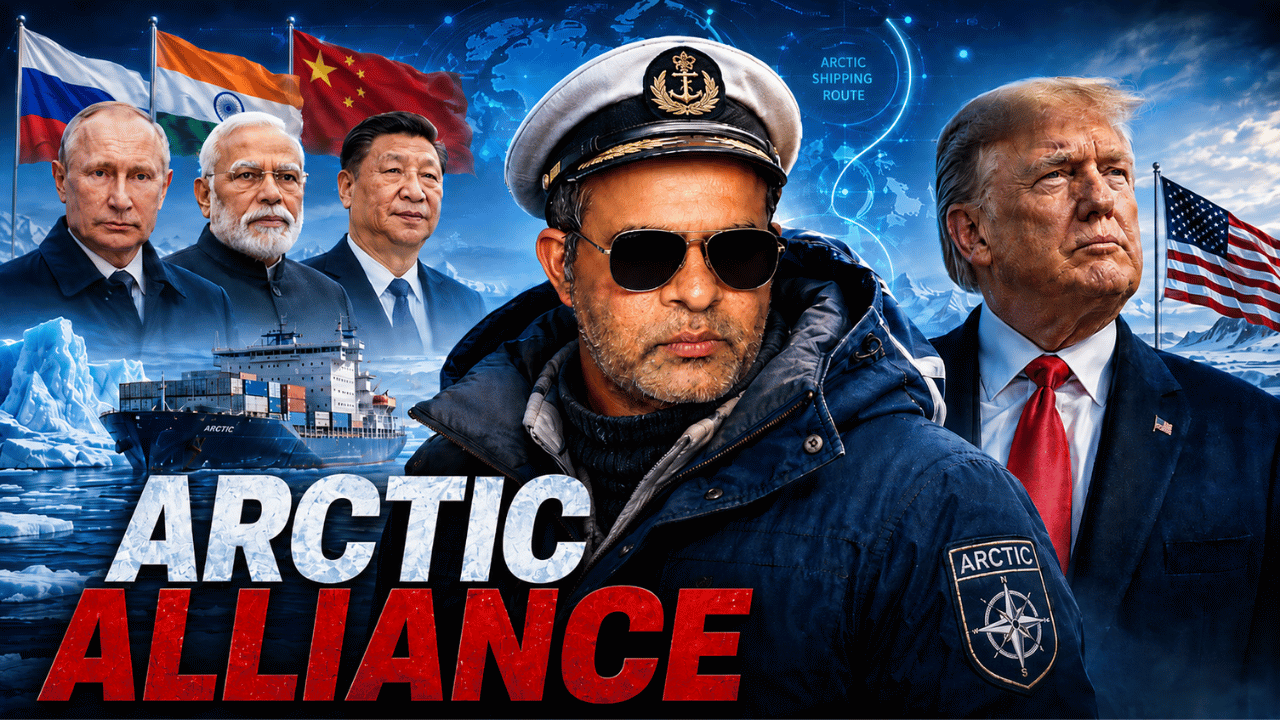
Vladimir Putin then publicly identified China and India together as two countries interested in expanding cooperation with Russia on the Northern Sea Route.
India followed by confirming that it intends to send its first pilot vessel through the route in 2027 while exploring cooperation with Russia in Arctic shipbuilding, ship repair, engines, hull construction and port infrastructure.
Then came perhaps the most consequential development: Russia acknowledged that it does not currently possess enough merchant shipbuilding capacity to expand Arctic trade at the scale it wants — and said China and India are proposing to participate in building that fleet.
These are no longer unrelated announcements.
Something larger is beginning to take shape.
Not a military alliance. Not a treaty bloc. Not an Arctic version of NATO.
But potentially something more durable economically: a functional India-Russia-China Arctic alliance built around ships, resources, ports, trade corridors and shared strategic vulnerabilities.
And each country arrives in the Arctic for a very different reason.
Russia Owns the Geography — But Needs Asia
Russia begins with the strongest hand.
Most of the Northern Sea Route runs along Russia’s enormous Arctic coastline. Moscow possesses ports, Arctic infrastructure and by far the world’s most capable fleet of nuclear-powered icebreakers.
Russia therefore controls something India and China cannot manufacture: geography.
But geography alone does not create a commercial corridor.
Russia’s problem is capacity.
An icebreaker can clear a shipping lane. It cannot replace the hundreds of tankers, bulk carriers and container vessels necessary to turn that lane into a major trading system.
Moscow has now admitted as much.
Russia has considerably more experience constructing specialized vessels for oil and LNG than building the enormous commercial fleet that would be needed for large-scale international container traffic.
This is where China and India become useful.
But Russia’s need for Asian cooperation goes beyond shipbuilding.
The war in Ukraine and Western sanctions fundamentally altered Russia’s trade geography. Europe was once the natural destination for enormous quantities of Russian energy. Increasingly, those resources are moving east.
China and India are now among Russia’s most important energy customers.
The Northern Sea Route makes that shift geographically more logical.
Instead of Russian cargo having to move through waters where Western governments can exercise greater influence over insurance, ports, inspections and sanctions enforcement, Arctic cargo can increasingly move east toward Asian markets.
This year alone, Russian crude shipments through the Northern Sea Route toward Asia have accelerated sharply.
The Arctic is therefore becoming something more important for Moscow than simply a shorter route.
It is becoming sanctions-resistant geography.
China Wants Something Russia Can Provide: Another Way Out
China’s problem is almost the opposite.
China does not lack ships.
It does not lack cargo.
And it certainly does not lack shipbuilding capacity.
China’s vulnerability is the geography through which much of that trade must travel.
The traditional China-Europe maritime route runs through the South China Sea, the Strait of Malacca, the Indian Ocean, Bab el-Mandeb, the Red Sea and the Suez Canal.
Each of those points represents efficiency during peacetime.
Each also represents vulnerability during crisis.
The Strait of Malacca has worried Chinese strategists for decades. Conflict in the Red Sea has demonstrated how quickly supposedly dependable commercial routes can become unstable. Suez remains indispensable precisely because there are so few serious alternatives.
The Arctic changes that calculation.
A Chinese vessel moving from Ningbo toward Northern Europe through the Northern Sea Route can travel north through the Pacific, cross the Bering Strait and move west along the Russian Arctic coastline.
For suitable cargo and during suitable seasons, that route can reduce transit time dramatically.
But the strategic importance is bigger than the number of days saved.
China gains an entirely different geographical pathway to Europe.
No Malacca.
No Bab el-Mandeb.
No Red Sea.
No Suez.
That is why Beijing’s Polar Silk Road should never have been interpreted merely as another infrastructure slogan.
China was looking for route diversification.
What has changed in 2026 is that the Polar Silk Road is beginning to move from concept toward scheduled commercial activity.
That matters.
Testing a route proves that a ship can cross it.
Scheduling ships through it proves that someone is beginning to ask whether an actual business can be built around it.
India’s Arctic Strategy Is Different — And More Interesting
India’s presence initially appears harder to explain.
China sits naturally at the Pacific entrance to the Arctic system.
India does not.
An Indian container ship traveling from Mumbai to Europe would not normally improve its economics by sailing east across Asia, entering the Pacific and then heading through the Arctic.
That would miss the point.
India’s Arctic strategy is not primarily about replacing Suez on India-Europe trade.
It is about connecting India to Russia and Eurasia through multiple directions simultaneously.
India already has the International North-South Transport Corridor connecting India through Iran and the Caspian toward Russia.
It is also developing the Chennai-Vladivostok Eastern Maritime Corridor, connecting India directly with Russia’s Far East.
Now place the Northern Sea Route above those systems.
Suddenly, India is not approaching the Arctic from one direction.
It potentially has two entrances into a wider Russian transportation network:
India → Iran → Caspian → Russia → Arctic
and
India → Chennai → Vladivostok → Russian Far East → Arctic
That changes the strategic meaning of India’s involvement.
India is not trying to become China.
India is trying to gain access.
Access to Russian Arctic energy.
Access to minerals.
Access to ports.
Access to shipbuilding contracts.
Access to polar shipping technology.
And perhaps most importantly, access to another Eurasian corridor that does not depend on the political success of any single mega-project.
India’s emerging connectivity map is increasingly diversified:
IMEC toward the West.
INSTC toward the northwest.
Chennai-Vladivostok toward the northeast.
And now potentially Arctic connectivity further north.
That is not redundancy.
It is leverage.
This Is Where the “Alliance” Begins to Make Sense
The word alliance will inevitably make some people uncomfortable.
India and China are not treaty allies.
They have a disputed border. They compete for influence in South Asia and the Indian Ocean. India has deliberately remained outside China’s Belt and Road Initiative.
None of that changes.
But alliances do not always begin with treaties.
Sometimes they begin with infrastructure.
Look at what is actually happening.
Russia controls the central Arctic route.
China is beginning to place scheduled commercial traffic through it.
India intends to test its own participation.
Russia says India and China may participate in building the merchant fleet necessary to scale Arctic trade.
Russian planners are discussing integration of the Trans-Arctic Transport Corridor with the North-South transport system.
India is simultaneously expanding its eastern maritime connection with Vladivostok.
The systems are beginning to overlap.
And Russia occupies the middle.
That is what makes this arrangement politically unusual.
India does not have to join China’s Belt and Road Initiative.
China does not have to join an Indian-designed corridor.
Both can connect independently to a Russian-centered Arctic system.
Russia becomes the common platform.
That means India and China can cooperate functionally in the Arctic even while competing fiercely elsewhere.
This is not an ideological alliance.
It is an alliance of overlapping necessities.
Russia needs commercial capacity and Asian markets.
China needs alternative shipping geography.
India needs diversified Eurasian connectivity.
Different problems.
Same infrastructure.
But the Arctic Is Still a Difficult Place to Build a Global Trade System
The current excitement should not become another round of Arctic hype.
The Northern Sea Route still has major limitations.
It remains heavily seasonal.
Ice conditions change.
Specialized vessels cost more.
Insurance can be more expensive.
Search-and-rescue infrastructure is limited compared with established global shipping corridors.
Russia itself does not yet possess the commercial fleet it needs.
And increasing Arctic activity is happening at exactly the same time that the region is becoming more militarized.
NATO is placing greater emphasis on the High North. Russia continues strengthening its Arctic military posture. China’s growing Arctic presence is increasingly watched through a security lens rather than purely an economic one.
The irony is obvious.
Russia and China are interested in Arctic shipping partly because it reduces exposure to geopolitical instability elsewhere.
But if the route becomes important enough, the Arctic itself could become another theater of strategic competition.
India will have to navigate that carefully.
New Delhi has no interest in turning commercial Arctic participation into another geopolitical dependency.
That is precisely why India’s ability to participate without becoming subordinate to either Russian or Chinese strategy will matter.
And Then Comes the Transpolar Sea Route
There is an even bigger long-term contradiction.
Russia’s Arctic advantage today comes from the Northern Sea Route hugging the Russian coastline.
That gives Moscow enormous leverage.
Ships rely on Russian icebreakers, Russian ports, Russian infrastructure and Russian navigation systems.
But the Northern Sea Route may not be the final Arctic route.
If Arctic sea ice continues retreating over the coming decades, another route could gradually become possible: the Transpolar Sea Route.
Instead of following the Russian coast, vessels would move farther north through the central Arctic Ocean.
Potentially, that route could be shorter.
It could also accommodate deeper-draft vessels because it would avoid some of the shallow coastal waters that constrain parts of the Northern Sea Route.
Most importantly, it would reduce Russia’s geographic advantage.
Today, climate change helps Russia.
Less ice makes the Northern Sea Route more usable.
But continued melting could eventually create a route that travels north of Russia’s own route.
That would be one of the great geopolitical ironies of Arctic development.
Russia could spend decades building ports, icebreakers, rail connections, terminals and commercial shipping capacity around the Northern Sea Route — only to discover that the same environmental change making the route valuable eventually creates a competitor that bypasses much of Russia’s infrastructure.
That future is not here yet.
But the possibility matters because the Arctic itself is still changing faster than the infrastructure being built around it.
The Arctic Is Becoming Part of Eurasia’s Economic Map
The most important development this week is therefore not that China sent another ship through Arctic waters.
It is not even that India plans to send one in 2027.
It is the convergence.
China is putting scheduled commercial traffic into the Arctic.
Russia is trying to expand the route into a broader transport corridor.
India is preparing to enter the same system.
India and China may help Russia build the merchant fleet Russia currently lacks.
Russia is linking its Arctic transportation strategy with north-south Eurasian corridors.
And India is simultaneously strengthening its own eastern connection to Russia.
Taken individually, these are shipping stories.
Taken together, they point toward something much larger.
Russia supplies the geography.
China supplies cargo and industrial scale.
India adds another giant market, shipbuilding partner and connection into the Indian Ocean.
That is why the emerging Arctic alignment deserves attention.
It does not need a treaty.
It does not require India and China to become friends.
It simply requires all three countries to recognize that the same Arctic infrastructure can solve different strategic problems for each of them.
And that may be enough.
Because the next major shift in global trade may not begin with a political declaration.
It may begin with seven ships, one new route — and three countries realizing that the top of the world can connect them in ways the old geography never could.