For most of the modern era, oil power meant ownership.
Saudi Arabia had oil. Russia had oil. Iran, Iraq and Venezuela had oil. Their geopolitical weight came from the simple fact that the world needed what sat beneath their soil.
India never had that advantage.
It imports most of the crude oil it consumes. By the traditional measure, that should make India structurally weak in the global oil system.
But that measure is becoming outdated.
The real value in the oil economy is no longer captured only by the country that pumps crude from the ground. Increasingly, it is captured by the country that can buy crude cheaply, refine it efficiently and sell finished products into markets facing shortages.
That is where India is gaining power.
Two recent developments reveal the strategy clearly.
India’s exports of diesel, gasoline and other refined products are rising sharply. At the same time, Reliance Industries is buying Venezuelan crude directly from PDVSA, reducing its dependence on international commodity traders.
These are not separate stories.
One explains the output.
The other helps explain the input.
Together, they point toward a larger transformation:
India is increasingly sourcing crude below global benchmark prices, refining it at scale and selling finished products into a much more valuable market.
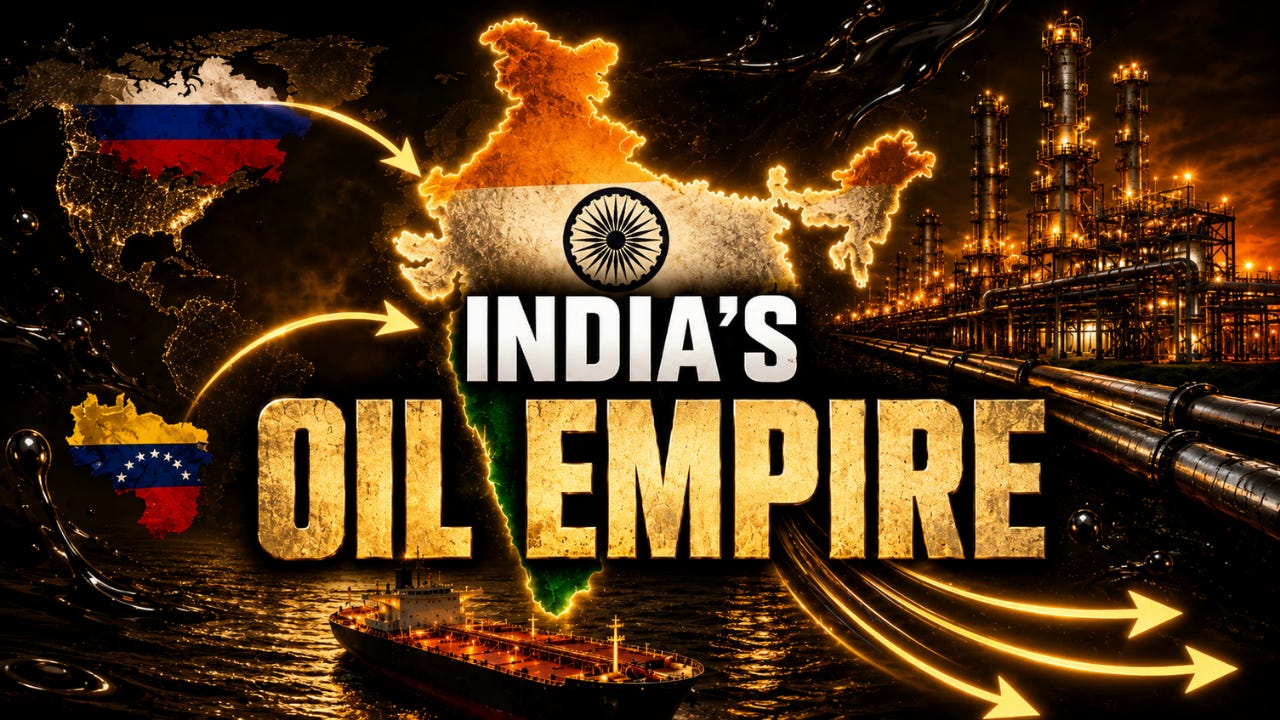
This is how India is building an oil empire without owning the oilfields.
The Market Is Moving Downstream
Crude oil remains essential, but crude is not what the global economy ultimately consumes.
Trucks need diesel. Aircraft need aviation fuel. Cars need gasoline. Industries need lubricants, petrochemicals and specialized fuels.
That distinction matters because the current energy system is facing a refining problem as much as a production problem.
Three forces are accelerating this shift.
The first is disruption around the Strait of Hormuz.
Hormuz is usually discussed as a crude-oil chokepoint, but the vulnerability is broader. Any conflict affecting Gulf refineries, product terminals or tanker traffic also restricts the movement of diesel, gasoline and aviation fuel.
A barrel of crude that cannot be refined is not immediately useful.
A refinery that cannot ship finished products is equally useless to the customer.
The second force is sanctions.
Sanctions have divided the oil market into producers that need buyers and consumers that need fuel. Russia, Venezuela and Iran still possess enormous reserves, but restrictions reduce the pool of available customers and complicate shipping, insurance, settlement and financing.
That creates discounted crude.
At the same time, the restriction of Russian and Venezuelan product exports can tighten global supplies of finished fuel.
India is positioned between these two markets.
It can buy discounted crude from producers facing limited access, process that crude through advanced refineries and export the finished products into markets where supply is tight.
The third force is inflation.
Higher diesel prices spread rapidly through transportation, agriculture, food distribution, manufacturing and logistics. Gasoline affects households directly. Aviation-fuel costs raise the price of travel and freight.
A crude shortage is a market problem.
A diesel shortage becomes an economic and political problem.
That is why refining capacity is becoming more strategically valuable.
India’s Fuel Exports Are Surging
India’s exports of light and middle distillates were expected to reach approximately 1.55 million barrels per day in July.
That is almost double the roughly 866,000 barrels per day exported in May and would represent one of the highest monthly levels recorded in recent years.
This surge is not simply a statistical recovery.
It means Indian refiners are buying more crude, operating at higher levels and directing larger volumes of diesel, gasoline and aviation fuel into international markets.
India is stepping into a global shortage.
But this creates an obvious question.
Where is the additional crude coming from?
The first answer is Russia.
Following Western sanctions, Russian oil was redirected away from traditional European buyers. India emerged as one of the largest alternative markets.
Russian crude arrivals into India reached approximately 2.73 million barrels per day in June, with another 2.57 million barrels per day expected in July.
These flows gave Indian refiners access to enormous volumes of crude that were frequently priced below competing global grades.
The model was simple:
Russia sold discounted crude.
India refined it.
The world bought the finished fuel.
Now India is expanding that model beyond Russia.
Venezuela Is the Next Source
Reliance Industries has begun purchasing Venezuelan crude directly from PDVSA.
That development matters because Venezuelan crude had previously moved heavily through international traders such as Vitol and Trafigura.
Those traders performed an important function. They arranged financing, shipping, logistics, regulatory compliance and resale. But they also captured part of the commercial value.
Reliance is now moving closer to the producer.
The company has already handled direct Venezuelan cargoes, including shipments of heavy crude suitable for its Jamnagar refining complex.
This does not mean Reliance is buying oil without reference to international benchmarks. Direct crude contracts are still commonly priced against Brent or another benchmark.
But the final transaction can include several discounts:
-
A quality discount for heavy or sour crude
-
A sanctions or political-risk discount
-
A discount created by limited buyer competition
-
A negotiated discount for long-term or large-volume purchases
-
Reduced intermediary costs when traders are bypassed
The exact direct price has not been disclosed.
But the commercial logic is clear.
PDVSA can receive a better net return by selling directly to a major refinery.
Reliance can potentially obtain a better price than it would through a reseller.
The trader loses part of the margin.
This is not merely an oil purchase.
It is the restructuring of the supply chain.
Reliance Is Built for This Market
The Jamnagar refining complex gives Reliance an advantage that many conventional refineries do not possess.
It can process a wide range of crude grades, including heavier and more difficult barrels. It can adjust product output according to market conditions. It is connected to large-scale marine infrastructure capable of receiving crude and exporting refined products.
This flexibility matters because discounted crude is not always easy to process.
A simple refinery may require lighter, sweeter and more expensive oil.
A sophisticated refinery can purchase heavier or less desirable crude at a discount and convert it into valuable products.
That difference turns refining complexity into geopolitical leverage.
Reliance is not merely buying what is available.
It is buying what many others cannot process as efficiently.
The cheaper crude becomes feedstock.
The refining system creates the value.
The export network captures the margin.
India Is Capturing More of the Oil Chain
India’s strategy now extends across several stages of the oil economy.
It secures crude from multiple suppliers.
It increasingly negotiates directly with producers.
It processes complex crude grades through large refineries.
It exports finished products into high-value markets.
Each stage captures a different layer of value.
India can benefit from the original crude discount.
It can reduce some intermediary costs.
It captures the refining margin.
It earns export revenue.
And it gains influence over countries that depend on Indian fuel supplies.
This is a fundamentally different form of oil power.
Saudi Arabia’s power begins at the wellhead.
India’s power begins at the refinery gate.
The Producer Is No Longer the Only Power Centre
Crude producers will remain indispensable.
Refineries cannot operate without crude.
But ownership of raw material does not guarantee control over the final market.
This is already visible in other strategic industries.
China does not dominate every critical mineral because it owns every mine. It dominates because it controls large portions of processing, refining and manufacturing.
The same principle applies to oil.
The producer controls extraction.
The refiner controls transformation.
And during periods of shortage, transformation can become the more valuable bottleneck.
A country may possess millions of barrels of crude and still lack sufficient diesel.
It may export oil while importing gasoline.
It may control reserves while depending on foreign refiners for usable energy.
This is the weakness India is exploiting.
The Refinery of the Multipolar World
India does not need to become another Saudi Arabia.
It does not need to discover the world’s largest oil reserves.
Its path to power lies elsewhere.
Russia and Venezuela need buyers.
Asia and other markets need fuel.
India sits between them with refining capacity, ports, trading networks and the ability to process difficult crude grades.
The emerging system is increasingly clear:
Russia and Venezuela supply discounted crude.
India converts it into usable energy.
The world pays for the finished product.
That is the real meaning of India’s rising fuel exports.
India is not simply importing more oil.
It is moving toward a position where it purchases raw energy from producers under pressure, processes it through world-class infrastructure and supplies the products that the global economy actually requires.
The old oil order rewarded the country with the largest reserves.
The emerging oil order may reward the country capable of buying almost any crude, refining it into almost any product and selling it into almost any market.
India is building that capability.
And that is how a country without giant oilfields can still build an oil empire.