A civilian nuclear programme is not the same thing as a nuclear-weapons programme.
But the distance between the two is determined by infrastructure.
A country possessing reactors, nuclear engineers, fuel-cycle knowledge, uranium-enrichment capacity and an established supply chain is far closer to a nuclear weapon than a country starting from zero.
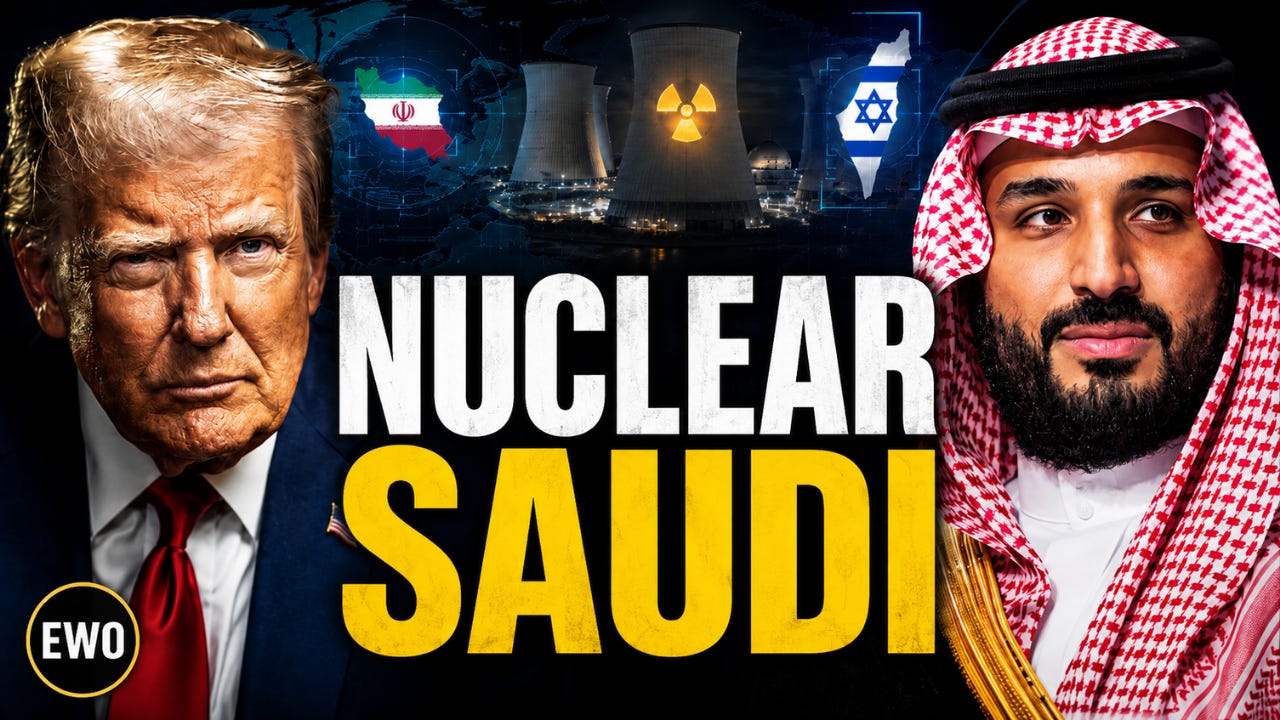
That is why America’s new nuclear agreement with Saudi Arabia matters.
The Trump administration has approved a 30-year civilian nuclear-cooperation agreement that would allow American companies to help build Saudi Arabia’s nuclear industry. The agreement must still pass through congressional review, but it reportedly leaves open the possibility of Saudi uranium enrichment and excludes some of the strongest safeguards Washington previously demanded from countries receiving American nuclear technology.
This is not America giving Saudi Arabia a nuclear bomb.
It may, however, be America giving Saudi Arabia a nuclear path.
This Is Not a Weapons Deal—But It Creates the Infrastructure
The agreement is known as a Section 123 Agreement, named after the relevant provision of the US Atomic Energy Act.
Such an agreement provides the legal foundation for American companies to transfer civilian nuclear technology, equipment, expertise, fuel and services to another country.
Saudi Arabia wants nuclear power partly because it wants to preserve more of its oil and gas for export, diversify its economy and develop industries capable of surviving beyond the petroleum era.
None of that is unusual.
The controversy lies in what Saudi Arabia has reportedly refused to surrender.
When the UAE signed its nuclear-cooperation agreement with the United States, it accepted the so-called Gold Standard: a permanent commitment not to enrich uranium or reprocess spent nuclear fuel.
Saudi Arabia has not accepted the same restriction.
The reported Saudi agreement also lacks the IAEA Additional Protocol, which would give international inspectors broader access and greater authority to investigate undeclared nuclear activities. A joint US-Saudi study could also examine the feasibility of domestic enrichment inside the kingdom.
Uranium enrichment has legitimate civilian uses. Low-enriched uranium can fuel nuclear reactors.
But the same basic technology can continue enriching uranium toward weapons grade.
The difference is not necessarily the machinery. It is how far the process is taken, how many centrifuges are operating, what material is being produced and whether inspectors can verify the programme.
That is why enrichment is called dual-use technology.
The agreement does not guarantee that Saudi Arabia will build a weapon. But it can create the engineers, facilities, knowledge and industrial ecosystem that would allow a future Saudi government to move more quickly if it ever made that decision.
Why Would America Take This Risk?
Washington’s calculation is straightforward:
If Saudi Arabia is determined to develop nuclear power, America would rather control the programme than leave it to China or Russia.
American involvement would make Saudi Arabia dependent on US technology, fuel arrangements, maintenance, replacement components, regulatory approvals and technical expertise for decades.
It would also keep American companies at the centre of projects potentially worth tens of billions of dollars while preventing Chinese and Russian companies from capturing one of the world’s largest prospective nuclear markets.
From Washington’s perspective, this is not simply an energy deal.
It is a long-term instrument of strategic control.
The United States believes that a Saudi programme built inside an American technological framework will be easier to monitor and influence than one constructed with Chinese or Russian assistance.
But there is another side to that calculation.
Saudi Arabia understands that Washington fears losing the kingdom to China. Riyadh is therefore using great-power competition to demand conditions the United States might previously have rejected.
This is how Saudi Arabia has managed to seek a civilian nuclear programme without permanently surrendering enrichment.
The most important warning came directly from Crown Prince Mohammed bin Salman, who said that Saudi Arabia would pursue a nuclear weapon if Iran developed one.
That does not prove Saudi Arabia currently intends to build a bomb.
It proves that Riyadh sees nuclear weapons as a possible future response to changes in the regional balance of power.
America Has Separated the Deal From Israel
Under the Biden administration, civilian nuclear cooperation was discussed as one component of a much larger arrangement.
Saudi Arabia would receive nuclear assistance and stronger American security guarantees. In return, Riyadh would normalize relations with Israel.
That linkage has now been removed.
The Trump administration stopped requiring Saudi recognition of Israel as a condition for progress on the nuclear agreement.
That changes the Israeli calculation considerably.
Saudi Arabia has no peace treaty with Israel and has not joined the Abraham Accords. Israel is therefore being asked to accept the emergence of advanced Saudi nuclear infrastructure without receiving formal Saudi recognition in exchange.
Washington may consider Saudi Arabia a manageable partner.
Israel cannot base its long-term security exclusively on the current relationship between the Saudi monarchy and the United States.
Governments change. Alliances change. Regimes can fall.
Nuclear infrastructure survives all three.
Saudi Arabia may be aligned with America today, but Israel must consider what that capability could mean under a different Saudi ruler thirty years from now.
America is therefore trading a possible future Israeli security risk for immediate strategic influence over Saudi Arabia.
Why Not Offer Iran the Same Civilian Nuclear Model?
This exposes the central contradiction.
Iran already possesses the capabilities that Saudi Arabia is seeking.
It has trained scientists, centrifuges, enrichment facilities and accumulated experience across the nuclear fuel cycle. The IAEA reported in February 2026 that Iran was the only non-nuclear-weapon state under the Nuclear Non-Proliferation Treaty known to have produced and accumulated uranium enriched to 60%.
That makes Iran’s programme more dangerous than Saudi Arabia’s current programme.
But it also creates a logical question:
Why not replace Iran’s dangerous independent enrichment programme with a tightly controlled, Western-supported civilian programme?
Such an agreement could require Iran to:
-
export or downblend its highly enriched uranium;
-
restrict enrichment to ordinary civilian levels;
-
dismantle or seal excess centrifuges;
-
prohibit reprocessing;
-
accept the IAEA Additional Protocol;
-
permit continuous monitoring;
-
and place future fuel supplies under international control.
In return, Iran could receive modern civilian reactors, guaranteed reactor fuel, nuclear-safety technology, sanctions relief and investment in its electricity system.
This would not mean trusting Iran.
It would mean constructing a system in which trust is unnecessary because Iran’s stockpiles, facilities and supply chains would be continuously verified.
There is already a precedent.
The 2015 nuclear agreement placed limits on Iran’s enrichment, centrifuges and uranium stockpile in exchange for sanctions relief. UN Security Council Resolution 2231 endorsed the framework, and the IAEA later confirmed that Iran had completed the nuclear steps required for its initial implementation.
The old agreement eventually collapsed, and Iran subsequently expanded its programme.
But that does not prove diplomacy was impossible.
It proves that nuclear agreements must be durable enough to survive changes of government and strong enough to impose consequences on either side for abandoning them.
The Difference Is Political Control
Washington does not treat Saudi and Iranian enrichment differently because the physics changes at the Persian Gulf.
The centrifuges do not know whether they are spinning inside an American partner or an American adversary.
The distinction is political.
Saudi Arabia exists inside the American strategic system. Iran challenges that system.
Saudi nuclear capability is therefore described as something that can be managed.
Iranian nuclear capability is described as something that must be eliminated.
Iran does have a far greater trust deficit. Its existing stockpile, history of undeclared activities, disputes with inspectors and regional military network justify much stronger restrictions than would be required for a new Saudi programme.
But that does not explain why Washington would permit Saudi Arabia to reject safeguards that it demands from Iran.
The American policy is not simply nuclear non-proliferation.
It is the selective distribution of nuclear latency:
Friendly governments may be permitted to approach the threshold under American supervision. Adversarial governments must remain far away from it.
Could Iran and Israel Eventually Become Partners Again?
Today, an Iran–Israel alliance appears impossible.
But it is not historically or geographically absurd.
Before the 1979 Iranian Revolution, Iran and Israel maintained extensive strategic, diplomatic, intelligence and commercial cooperation. Israel viewed non-Arab Iran as part of its “periphery doctrine”—a network of relationships with non-Arab states capable of balancing hostile Arab powers. Iran supplied Israel with oil, while both countries shared concerns about powerful Arab nationalist governments.
Their current hostility is therefore not produced by geography alone.
It is produced by political systems, ideology and the US-led regional order that emerged after 1979.
A future Iranian government that recognized Israel, abandoned proxy attacks and accepted a verifiable civilian nuclear settlement could fundamentally change the regional map.
Israel and Iran are both powerful non-Arab states that remain strategically isolated within the wider Middle East.
Remove the proxy networks and American alliance structure, and both countries face a similar problem: neither can permanently trust the surrounding regional order.
A Future India–Iran–UAE–Israel System
This opens the possibility of a very different regional grouping:
India–Iran–UAE–Israel
This should not be understood as an immediate prediction. It would require a historic Iran–Israel peace agreement and a wider regional settlement.
But structurally, the four countries possess highly complementary assets.
India provides the market, manufacturing capacity, investment, technology and naval presence.
Iran provides energy, geography, access to Central Asia and the continental connection between the Indian Ocean and Eurasia.
The UAE provides capital, ports, aviation, financial networks and global logistics.
Israel provides advanced technology, intelligence capabilities, water systems, agriculture and access toward the eastern Mediterranean.
Part of this architecture already exists.
India, Israel and the UAE cooperate through I2U2 alongside the United States, focusing on areas including energy, food security, transportation, water and private investment. India separately maintains its connection with Iran through Chabahar, which provides access toward Afghanistan and Central Asia without relying on Pakistan.
An Iran–Israel peace could eventually connect these separate systems:
India and the Arabian Sea → UAE ports → Iranian energy and continental routes → Israel and the Mediterranean.
That would be more than a military alliance.
It would be an integrated trade, energy and technology architecture.
The Alternative: Turkey–Pakistan–Saudi Arabia
Turkey, Pakistan and Saudi Arabia are already moving toward a more formal security arrangement.
Pakistan and Saudi Arabia have a mutual-defence relationship, while the three countries have prepared a draft trilateral defence agreement after extended negotiations.
This grouping is more realistic in the immediate future because its military foundations are already developing.
But it is primarily threat-driven.
Saudi Arabia supplies money and energy. Turkey supplies a growing defence industry. Pakistan contributes manpower, military experience and nuclear deterrence.
That can produce a formidable security arrangement.
It does not necessarily produce an integrated economic order.
Turkey and Saudi Arabia retain competing leadership ambitions. Pakistan remains economically dependent on external support. Their cooperation is real, but it is also transactional.
An India–Iran–UAE–Israel system would operate differently.
Its strength would come from complementary geography, corridors, technology, capital and trade—not merely from a shared enemy.
America Is Not Closing the Nuclear Door
The Saudi agreement reveals what American nuclear policy has become.
Washington is not eliminating every possible nuclear pathway.
It is deciding who may possess one.
Saudi Arabia is being allowed to preserve a future option because Washington believes it can control the kingdom.
Iran is being denied the same option because Washington cannot control Iran.
But by strengthening Saudi Arabia without securing Saudi normalization with Israel, America may be creating a future strategic threat that Israel cannot ignore.
The immediate story is about civilian nuclear energy.
The larger story is about the next Middle Eastern order.
And the real question is no longer simply whether Saudi Arabia intends to build a nuclear weapon today.
It is whether America is constructing the infrastructure that could allow Saudi Arabia to make that decision tomorrow.