Turkey has spent years trying to project influence into India’s strategic neighborhood. It has supported Pakistan diplomatically, raised Kashmir on international platforms, cultivated military-industrial ties with Islamabad, and attempted to position itself as a voice for a wider Islamic geopolitical bloc.
India’s response is now becoming visible.
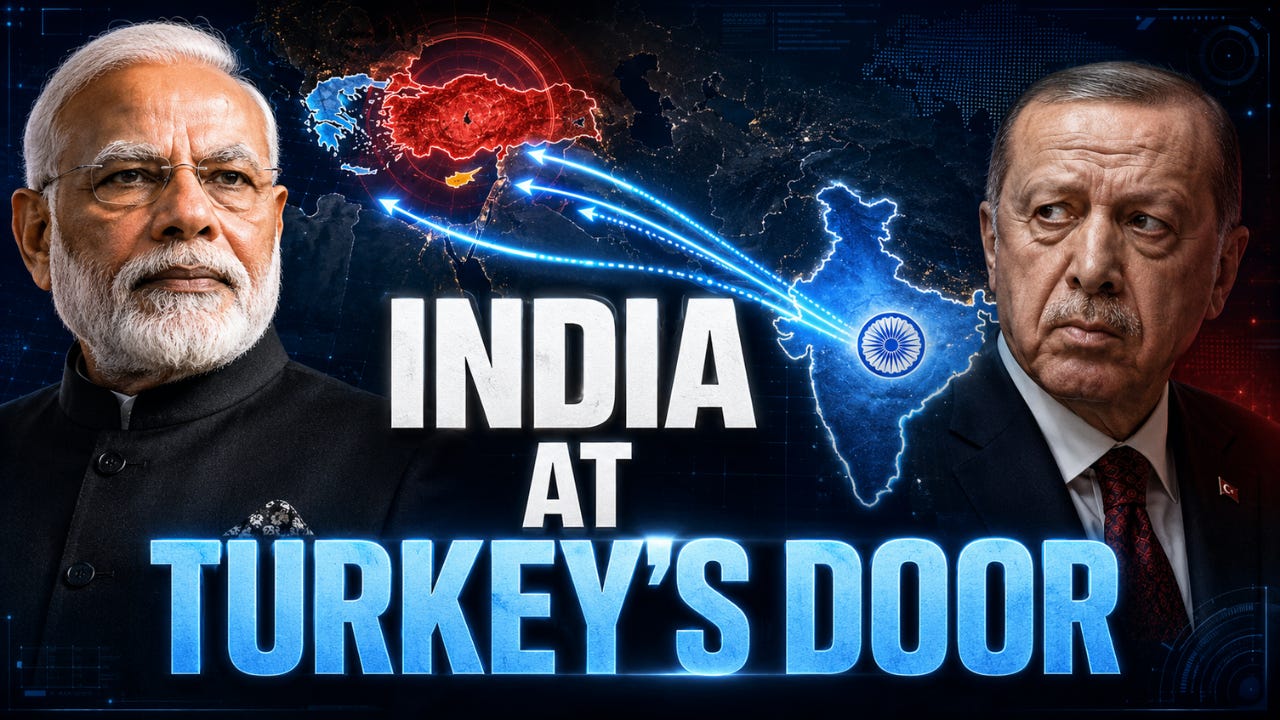
New Delhi is not confronting Turkey directly. It is doing something more structural: it is building relationships around Turkey’s own strategic perimeter. Greece, Cyprus, Armenia, and the India–Middle East–Europe Economic Corridor are not isolated diplomatic moves. Together, they form a new geography of Indian leverage.
This is the real story behind India’s growing engagement with Greece and the Eastern Mediterranean. It is not merely about bilateral friendship. It is about the slow emergence of a counter-network around Turkey’s most sensitive dependencies: maritime access, Europe-Asia connectivity, the Caucasus, Cyprus, and the Aegean balance.
India is not moving into Turkey’s backyard because it wants a confrontation with Ankara. India is moving there because Turkey inserted itself into India’s security equation.
Turkey’s Strategic Bet
Turkey’s contemporary foreign policy rests on a central assumption: geography is power.
Turkey sits between Europe and Asia. It borders the Black Sea, the Eastern Mediterranean, the Caucasus, the Middle East, and the Balkans. This allows Ankara to imagine itself not merely as a state, but as a bridge, a gatekeeper, and a civilizational hub.
This ambition is not limited to economics. It has also shaped Turkey’s defense exports, its support for Azerbaijan, its outreach to Pakistan, its involvement in Muslim-world diplomacy, and its desire to be treated as an indispensable power between East and West.
For India, this matters because Turkey’s Pakistan policy has moved beyond rhetorical sympathy. Turkey has repeatedly positioned itself against India’s Kashmir narrative, while Pakistan has become one of Ankara’s most important defense and diplomatic partners in South Asia. After the Pahalgam attack and Operation Sindoor, India’s view of Turkey hardened further. The May 2025 India-Pakistan confrontation began after India launched strikes on Pakistan and Pakistan-administered Kashmir following the attack in Kashmir; Reuters described it as the worst clash between the nuclear-armed neighbors in more than two decades.
The point is not that Turkey and India are direct military adversaries. They are not.
The point is that Turkey has tried to influence the India-Pakistan balance from outside South Asia. Once that happens, India begins to ask a different question: if Turkey can operate near India’s vulnerabilities, why should India ignore Turkey’s?
That is where Greece, Cyprus, Armenia, and IMEC enter the picture.
Greece Is Not Just Another European Partner
India’s relationship with Greece changed significantly in August 2023, when Prime Minister Narendra Modi visited Athens. It was the first visit by an Indian prime minister to Greece in forty years, and the two countries elevated the relationship to a strategic partnership. The India-Greece joint statement emphasized defense, security, trade, investment, maritime cooperation, migration, and connectivity.
This was not symbolic diplomacy alone. It came at a time when India was expanding westward through trade corridors, defense exports, port access, and maritime strategy. Greece sits at the edge of Europe, the Eastern Mediterranean, the Balkans, and the Aegean. It is also Turkey’s historic rival inside NATO.
That makes Greece uniquely important.
For Turkey, Greece is not simply a neighbor. It is a maritime constraint. The Aegean Sea, Greek islands, Cyprus, and Eastern Mediterranean energy disputes all shape Turkish strategic planning. When India builds a serious defense and connectivity relationship with Greece, Ankara cannot treat it as a routine diplomatic development.
The relationship deepened further in February 2026, when India’s Defence Minister Rajnath Singh and Greek Defence Minister Nikos Dendias met in New Delhi. The two sides signed a Joint Declaration of Intent on strengthening defense-industrial cooperation and exchanged a Bilateral Military Cooperation Plan for 2026. India’s Ministry of Defence described the agreement as the starting point for a five-year roadmap linking India’s Aatmanirbhar Bharat defense ecosystem with Greece’s Agenda 2030 defense reforms.
This matters because India is no longer only importing defense technology. It is increasingly exporting systems, platforms, and operational experience. For a country like Greece, which faces a long-running strategic rivalry with Turkey, Indian defense cooperation introduces a new variable into the regional equation.
The BrahMos Question
The most sensitive question is not whether India has sold BrahMos missiles to Greece or Cyprus. It has not.
The more important point is that the possibility itself changes the strategic conversation.
BrahMos is a supersonic cruise missile developed by India and Russia. India’s defense ministry has described it as a missile capable of cruising at Mach 2.8. In the Aegean and Eastern Mediterranean, where geography is compressed and naval movement is constrained by islands, coastlines, and chokepoints, a fast anti-ship missile system would create serious planning problems for any navy.
This is why the BrahMos discussion matters even before any transfer occurs. Deterrence is not only about deployed weapons. It is also about what planners must assume could appear in the future.
Turkey now has to consider a scenario in which Indian defense technology enters regions where Turkish naval and air planning are already complicated: the Aegean, Cyprus, and the Eastern Mediterranean.
That is not a formal alliance against Turkey. But it is a pressure point.
IMEC and the Geography Turkey Cannot Ignore
The most consequential dimension is not military. It is economic geography.
Turkey’s long-term strategic value depends on being an unavoidable bridge between Asia and Europe. The India–Middle East–Europe Economic Corridor challenges that assumption.
The IMEC memorandum was signed in 2023 by India, the United States, the UAE, Saudi Arabia, France, Germany, Italy, and the European Union. The plan is to connect India to Europe through maritime links, rail, energy infrastructure, digital connectivity, and clean energy corridors across the Gulf and Eastern Mediterranean.
The crucial point is simple: Turkey is not central to the route.
That is why Ankara reacted strongly. President Recep Tayyip Erdoğan criticized the project for bypassing Turkey and argued that there could be “no corridor without Turkey.”
That statement reveals the dependency.
Turkey’s concern is not merely that India is strengthening ties with Greece. Turkey’s deeper concern is that India, the Gulf states, Israel, Europe, and the United States are exploring a connectivity architecture that reduces Turkey’s role as the default bridge between East and West.
If Asia can reach Europe through India, the Gulf, Israel, and Greece, then Turkey’s geographic monopoly weakens.
That is why Greece matters so much. Greece is not only Turkey’s rival; it is also a potential European landing point for India’s westward connectivity strategy. The more India explores Greek ports and Eastern Mediterranean infrastructure, the more Turkey sees an alternative map forming around it.
Armenia Completes the Caucasus Angle
Armenia is the other important piece.
India’s defense relationship with Armenia has expanded rapidly in recent years. Armenia has reportedly signed defense contracts with India worth more than $1.5 billion, including Pinaka rocket launchers, ATAGS artillery systems, Akash air defense systems, anti-drone systems, and other equipment.
This matters because Armenia sits across from Azerbaijan, which is closely aligned with Turkey and has had defense and diplomatic support from Pakistan. From India’s perspective, Armenia is not just a small Caucasus state. It is a strategic pressure point within a Turkey-Azerbaijan-Pakistan triangle.
India’s defense exports to Armenia do not create a formal military bloc. But they do create a pattern.
India is strengthening countries that sit near Turkish influence zones. Greece in the Aegean. Cyprus in the Eastern Mediterranean. Armenia in the Caucasus. IMEC across the Gulf-Europe route.
Individually, each relationship can be explained as normal diplomacy.
Together, they form a strategic map.
This Is Not India Versus Muslim Countries
It is important to frame this correctly.
India’s emerging Turkey strategy is not an anti-Muslim strategy. That framing is both analytically wrong and politically weak.
India has strong relations with several Muslim-majority countries, especially in the Gulf. The India-UAE Comprehensive Economic Partnership Agreement has significantly expanded bilateral commerce; India’s government reported that bilateral merchandise trade nearly doubled from $43.3 billion in FY 2020–21 to $83.7 billion in FY 2023–24 after CEPA, with a target of $100 billion in non-oil trade by 2030.
So the issue is not religion. The issue is Turkey’s attempt to use religious identity as geopolitical leverage, especially through Pakistan and Kashmir.
That distinction is crucial.
India is not countering Muslim countries. It is countering a specific Turkish geopolitical project: a neo-Ottoman, pan-Islamist, defense-export-driven strategy that tries to expand Turkish influence from the Eastern Mediterranean to the Caucasus and South Asia.
This is why India can deepen ties with the UAE, Saudi Arabia, Oman, Egypt, Indonesia, and Iran in different strategic lanes while still pushing back against Turkey.
The conflict is not civilizational. It is structural.
The New Logic of Indian Power
For decades, India was often described as a cautious power: defensive, reactive, and reluctant to project influence beyond its immediate neighborhood.
That description is becoming outdated.
India’s current behavior is different. It is building corridors, exporting defense systems, investing in ports, strengthening naval partnerships, and cultivating strategic relationships in regions that once seemed far outside India’s traditional map.
The Eastern Mediterranean is one of those regions.
Cyprus, Greece, Armenia, Israel, the UAE, and IMEC all connect to the same larger story: India’s strategic geography is expanding westward.
This is not empire-building in the old colonial sense. It is dependency management.
India depends on secure maritime routes. It depends on access to Europe. It depends on energy flows from the Gulf. It depends on preventing hostile coalitions from forming around Pakistan. It depends on reducing the leverage of states that try to internationalize Kashmir against India.
Turkey has inserted itself into several of those dependencies.
India is now inserting itself into Turkey’s.
Conclusion: India at Turkey’s Door
The India-Greece partnership is not merely about trade or defense visits. It is part of a wider redistribution of strategic pressure.
Turkey tried to build influence near India through Pakistan. India is now building options near Turkey through Greece, Cyprus, Armenia, and the Eastern Mediterranean corridor system.
Turkey’s advantage has always been geography. But geography becomes less powerful when other states build alternative routes, alternative partnerships, and alternative pressure points.
That is what India is doing.
India is not surrounding Turkey militarily. It is doing something subtler and more durable. It is building a network of relationships that reduces Turkey’s ability to act as an uncontested bridge, gatekeeper, and pressure broker.
That is why Turkey has to watch India more closely.
India is no longer only defending its own backyard.
It is moving into Turkey’s.