
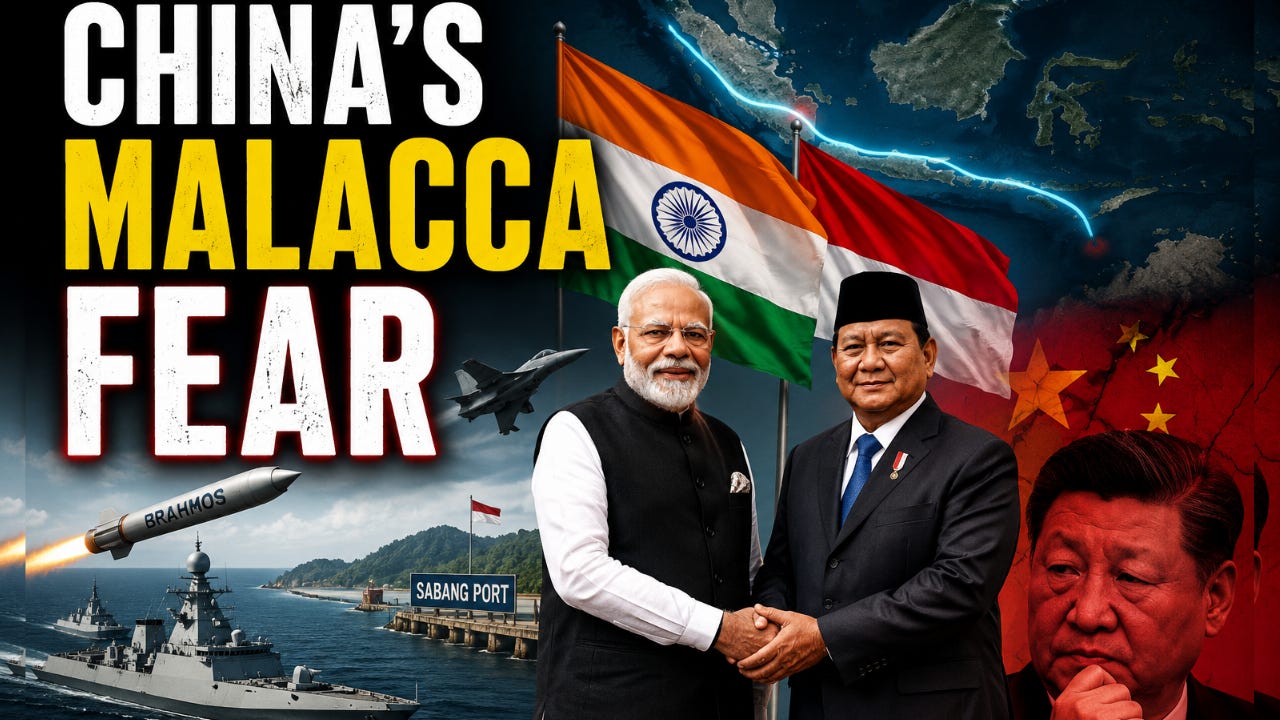
India and Indonesia have entered a new phase in their bilateral relationship. While recent agreements signed during Prime Minister Narendra Modi’s visit to Jakarta have largely been reported as defense and economic cooperation, their broader significance lies in the gradual emergence of a new strategic architecture in the Indo-Pacific.
The partnership extends beyond diplomatic symbolism. It reflects the convergence of two countries attempting to reduce their respective strategic vulnerabilities through deeper cooperation in maritime security, critical minerals, defense industrial collaboration and regional supply chains.
Viewed through the framework of strategic dependencies, the rationale behind the partnership becomes considerably clearer.
Geography Creates Strategy
Few maritime regions are as strategically important as the Strait of Malacca.
Connecting the Indian Ocean with the South China Sea and the Pacific Ocean, Malacca remains one of the busiest commercial waterways in the world. More than 90,000 vessels transit the strait annually, carrying roughly one-quarter of global traded goods.
For India, this maritime corridor represents a critical economic dependency. Nearly half of India’s external trade—and almost all of its trade with East Asia—passes through this narrow sea lane.
Indonesia, meanwhile, occupies one of the most influential geographic positions surrounding the strait. Its islands effectively overlook one of the world’s principal maritime chokepoints, making Indonesia indispensable to any long-term Indo-Pacific security architecture.
Rather than seeking dominance, India increasingly appears focused on ensuring the uninterrupted functioning of this maritime system.
The Andaman–Sabang Maritime Architecture
India’s strategic position begins with the Andaman and Nicobar Islands.
Unlike naval task forces that require continuous deployment and maintenance, these islands provide India with a permanent military presence near Southeast Asia. Their location enables maritime surveillance, naval logistics, air operations and rapid deployment throughout the eastern Indian Ocean.
India’s only tri-service military command is located on these islands, integrating the Army, Navy and Air Force under a unified operational structure.
Indonesia complements this geographic advantage through Sabang Port, situated in Aceh Province near the northern entrance to the Strait of Malacca.
Recent agreements reaffirm cooperation on the development of Sabang as a logistics and maritime support facility. While often characterized in geopolitical commentary as a military asset, Sabang’s practical value lies in maintenance support, humanitarian assistance, logistics, naval visits and maritime coordination.
Together, the Andaman and Nicobar Islands and Sabang Port create a distributed maritime network capable of improving domain awareness and enhancing regional stability without requiring permanent overseas military bases.
Defense Cooperation Beyond Arms Sales
Defense cooperation has become another pillar of the bilateral relationship.
Indonesia’s interest in acquiring India’s BrahMos supersonic cruise missile and Astra beyond-visual-range air-to-air missile reflects a broader shift in regional defense procurement.
These systems strengthen Indonesia’s ability to defend its maritime approaches while simultaneously expanding India’s growing defense industrial base.
However, the strategic significance extends beyond individual weapons systems.
Indonesia has historically operated Russian-origin military platforms, including the Su-27 and Su-30 fighter aircraft. India possesses extensive operational experience integrating indigenous missile systems onto similar Russian platforms.
This creates an important technological bridge.
Rather than merely exporting weapons, India increasingly exports interoperability—the ability for partner militaries to integrate communication systems, logistics, training and operational planning.
As regional security challenges evolve, interoperability may become more valuable than any individual weapons platform.
ASEAN’s Search for Strategic Diversification
The evolution of India’s relationship with Indonesia also reflects broader changes occurring within Southeast Asia.
China remains ASEAN’s largest trading partner and an indispensable economic actor. Nevertheless, territorial disputes in the South China Sea, combined with increasing strategic competition between Beijing and Washington, have encouraged many ASEAN states to diversify their external partnerships.
Few Southeast Asian governments seek confrontation with China.
Equally, few wish to become excessively dependent upon any single external power.
This strategic balancing has created opportunities for countries capable of contributing to regional stability without demanding exclusive alignment.
India increasingly occupies that position.
Its expanding relationships with Indonesia, Vietnam, Singapore, Malaysia, Thailand and the Philippines illustrate a broader regional strategy centered upon maritime security, economic integration and defense cooperation.
Rather than replacing China, India is positioning itself as an additional strategic option.
Critical Minerals and Economic Security
Economic considerations are equally significant.
Indonesia possesses the world’s largest known nickel reserves and currently accounts for approximately 42 percent of global nickel production.
Nickel has become indispensable for electric vehicle batteries, energy storage systems, stainless steel production and numerous advanced manufacturing sectors.
Over the past decade, Chinese companies invested more than $30 billion into Indonesia’s downstream nickel industry, financing smelters, processing facilities and refining capacity.
These investments accelerated Indonesia’s industrial development while simultaneously creating substantial dependence upon Chinese capital and technology.
Indonesia is now attempting to diversify that dependency.
India’s expanding electric vehicle industry, semiconductor ambitions, electronics manufacturing and defense industrial base require secure long-term access to critical minerals.
Direct investment into Indonesian mining and processing therefore serves the interests of both countries.
Indonesia gains additional investors and export markets.
India secures greater resilience within strategically important supply chains.
Strategic Dependencies Explain the Partnership
The India–Indonesia relationship illustrates a broader transformation occurring throughout the Indo-Pacific.
Rather than building traditional military alliances, countries increasingly seek to reduce vulnerabilities created by concentrated dependencies.
For Indonesia, diversification reduces excessive reliance on any single external partner.
For India, cooperation strengthens maritime security, expands regional influence and secures access to critical industrial inputs.
Defense cooperation, maritime infrastructure, supply-chain resilience and economic integration therefore represent interconnected components of a much larger strategic framework.
This partnership is not solely about bilateral relations.
It contributes to the gradual emergence of a more distributed regional order in which multiple middle powers cooperate to preserve stability while maintaining strategic autonomy.
Conclusion
India’s Indonesia pivot should not be interpreted as a sudden geopolitical realignment.
Instead, it represents the logical convergence of complementary strategic interests.
One country possesses indispensable geography.
The other possesses growing defense capabilities, expanding industrial demand and increasing regional influence.
Together, they are constructing a long-term partnership spanning maritime security, defense industrial cooperation, critical minerals and regional trade.
Whether this partnership ultimately transforms the balance of power in the Indo-Pacific remains to be seen.
What is already clear, however, is that both New Delhi and Jakarta increasingly view each other not simply as diplomatic partners, but as essential components of their long-term strategic resilience.
In an era increasingly defined by dependency management rather than territorial expansion, that may prove to be the most significant development of all.